
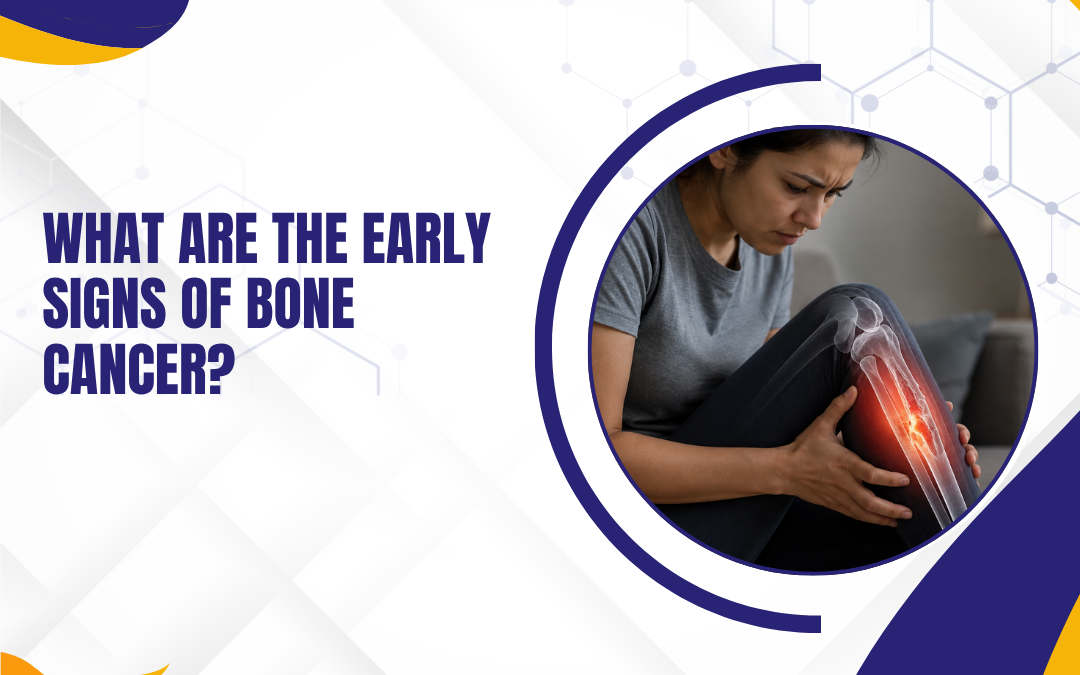
Early signs of bone cancer are often subtle and easy to attribute to something less serious. Deep bone pain that worsens at night, a firm or unexplained swelling near a joint, reduced mobility in a limb, and fractures from minor trauma are the key indicators that consistently appear before a confirmed diagnosis. These symptoms frequently get mistaken for arthritis, a sports injury, or general wear, which is what delays the average diagnosis by several weeks or months. Knowing the specific patterns that point to a bone tumour rather than a routine injury is what changes that outcome.
According to Dr. Aanchal Bhatia, orthopedic oncologist in Bangalore, “Night pain that wakes a child from sleep is not growing pains. Bone pain that doesn’t settle with rest needs an X-ray. Catching it early is the difference between saving a limb and losing one.”
What Bone Symptoms Should Not Be Ignored?
Most patients had at least one of these patterns for weeks before anyone took it seriously.
Pain that won’t settle at night: Muscle injuries ease with rest. Bone tumour pain doesn’t. It sits deep, gets worse through the night, and comes back even after painkillers. Two weeks of this, with no clear cause, is enough reason to get an X-ray done.
A lump near a bone that keeps growing: Firm, slow-growing swelling close to a bone needs a clinical eye on it, not a wait-and-see approach. The fact that it isn’t painful changes nothing. Painless lumps near bone get investigated just as seriously.
A fracture from an unlikely cause: A bone that breaks from a minor fall or something as ordinary as stepping off a kerb was already weakened from within. That’s a pathological fracture. For some patients, it’s the first moment anyone realises a tumour has been there all along.
A joint that keeps stiffening: A knee or shoulder that gradually loses range of motion, with no injury to explain it, usually gets put down to age. When there’s a lesion growing in the bone nearby, the stiffness keeps worsening and physiotherapy doesn’t shift it.
Catching any of these early keeps limb-preserving surgery a realistic option. For specialist evaluation, learn more about bone cancer treatment.
Already two weeks in and the pain still isn’t settling? See a bone tumour specialist before trying anything else.
Do Symptoms Vary Across Bone Cancer Types?
Considerably, and the differences are clinically meaningful.
Osteosarcoma most commonly affects teenagers and young adults. Pain and swelling near the knee or upper arm builds over weeks and gets dismissed as a sports injury far too often. That assumption is one of the main reasons diagnosis is delayed by months.
Ewing’s sarcoma tends to affect younger children and presents differently. Fever alongside bone pain is the pattern that sets it apart. A paediatrician is often consulted first, but a musculoskeletal oncologist needs to be involved early.
Metastatic bone disease is worth considering in adults previously treated for breast, lung, prostate, kidney, or thyroid cancer. New bone pain at a previously unaffected site, or a fracture from minimal impact, needs oncological evaluation first, not orthopaedic management.
Benign bone tumours including giant cell tumour, aneurysmal bone cyst, and osteochondroma can produce pain and swelling that looks clinically identical to a malignant lesion. A carefully planned biopsy is what confirms the difference, and where it’s placed matters considerably.
For more on when a bone tumour is actually cancerous, read about bone tumours and when they require treatment.
Why Choose Dr. Aanchal Bhatia for Bone Cancer Evaluation in Bangalore?
Dr. Aanchal Bhatia trained in Orthopaedics at Ramaiah Medical College before completing her Fellowship in Musculoskeletal Oncology at Max Super Speciality Hospital, Saket, New Delhi. She holds membership with the Indian Musculoskeletal Oncology Society (IMSOS), has 12 peer-reviewed publications in indexed journals, and limits her clinical practice to bone and soft tissue tumour cases. Patients are seen by a specialist from the first appointment, without being passed through a general orthopaedic setup first.
Her diagnostic process follows a deliberate sequence: clinical examination, then imaging, and a biopsy only when the findings indicate one is necessary. For patients in Bangalore dealing with bone pain that hasn’t resolved, a growing lump near a joint, or a fracture without a proportionate cause, a dedicated musculoskeletal oncologist should be the first specialist involved, not the last. Call 9289099511 to book your consultation.
Frequently Asked Questions
1. Is bone pain at night always a sign of cancer?
Not always, but persistent night bone pain needs specialist evaluation.
2. At what age does bone cancer commonly occur?
Osteosarcoma peaks in teens; Ewing’s sarcoma affects children under 20.
3. Can early bone cancer be treated without amputation?
Yes, most early-stage cases are eligible for limb-preserving surgery.
4. How long should I wait before seeing a doctor for a bone lump?
Any bone lump persisting beyond two weeks needs prompt assessment.
5. Can bone cancer be mistaken for arthritis?
Yes, early bone cancer often mimics arthritis or injury, which is why imaging matters.
Reference
Disclaimer: This article is for educational purposes only. Consult a qualified orthopedic oncologist if you have persistent bone pain, swelling, or an unexplained fracture.