
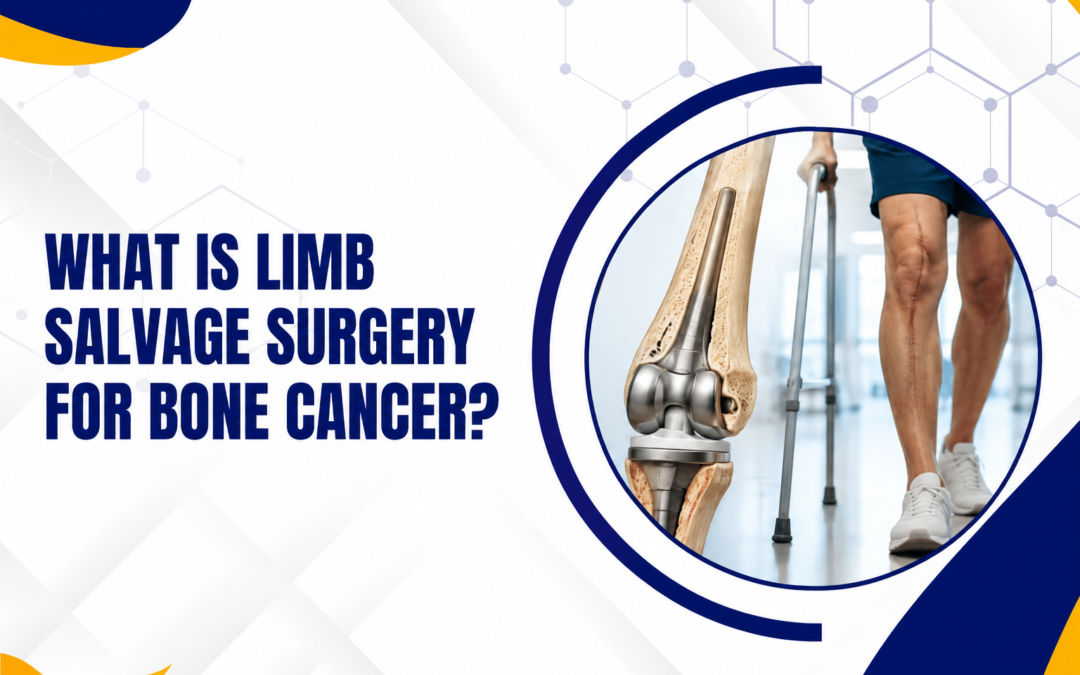
Limb salvage surgery, also called limb-sparing surgery, takes out the bone cancer tumour along with a thin margin of tissue around it. No amputation needed. Around 90 percent of bone tumour patients qualify for this today. Once the tumour’s gone, the missing bone and joint get rebuilt with a metal implant, bone graft, or donor bone, so the limb still works the way it should. For most patients now, it’s simply the first option on the table, not some exception reserved for a lucky few.
According to Dr. Aanchal Bhatia, orthopedic oncologist in Bangalore, “Limb salvage isn’t a compromise on cancer control. Oncologic clearance comes first, always. Function comes right after, and most patients don’t have to choose between the two.”
Who Is a Candidate for Limb Salvage Surgery?
Not every bone tumour qualifies for this approach. So it comes down to a handful of specific factors, and it’s rarely just one scan result that decides it.
Tumour location and size: Tumours confined to one segment of bone, without major nerve or vessel involvement, are the strongest candidates. Location near a major joint changes the reconstruction options, not the eligibility itself.
Response to chemotherapy: With osteosarcoma and Ewing’s sarcoma, a tumour that shrinks well on neoadjuvant chemotherapy opens up a wider surgical margin. Poor response narrows it, and that’s checked on imaging before any final call.
Stage at diagnosis: Localized disease, without spread to the lungs or other bones, is what makes limb salvage realistic. Metastatic cases still get individual evaluation, but the options look different.
Age and bone growth: Children with open growth plates need reconstruction that accounts for future growth, not just the current defect. Expandable prostheses exist for exactly this. Not every implant behaves the same way in a growing child.
A proper evaluation is the only way to know where you stand. The full scope of bone cancer treatment available in Bangalore covers more ground than most expect.
A tumour diagnosis doesn’t mean the limb is gone by default. Talk to a specialist first.
How Is Limb Salvage Surgery Performed?
The procedure moves through stages, and each one shapes what the final reconstruction ends up looking like.
Tumour resection: The affected bone segment comes out first, along with a margin of healthy tissue around it. Margins get decided before the incision, not adjusted mid surgery.
Reconstruction choice: A custom prosthesis, bone graft, or biological reconstruction such as recycled tumour bone replaces what’s removed. The choice depends on defect size and site.
Nerve and vessel preservation: Where major vessels or nerves sit close to the tumour, careful dissection keeps them intact wherever oncologically safe. Sometimes it isn’t possible, and that gets discussed upfront.
Post-surgical rehabilitation: Physiotherapy starts early to rebuild strength and range of motion around the reconstructed joint. Recovery timelines vary by procedure type and site.
Radiotherapy is sometimes the better route instead of surgery. Our piece on Ewing’s sarcoma treatment covers when that applies.
Why Choose Dr. Aanchal Bhatia for Limb Salvage Surgery in Bangalore?
Dr. Aanchal Bhatia trained in Orthopaedics at Ramaiah Medical College, then went on to complete her Fellowship in Musculoskeletal Oncology at Max Super Speciality Hospital, Saket, New Delhi, with focused work in limb salvage reconstruction and prosthetic replacement. She’s a member of the Indian Musculoskeletal Oncology Society (IMSOS), has 12 peer-reviewed publications to her credit, and focuses exclusively on bone and soft tissue tumour cases. Patients get a specialist from the first visit itself. No general orthopaedic setup in between.
Her reconstruction planning tracks the tumour’s response to chemotherapy, where exactly it sits, and what’s realistically achievable for the patient in the long run. The choice between a prosthesis, a graft, or biological reconstruction is discussed openly.
Frequently Asked Questions
1. What is limb salvage surgery?
Surgery removing the bone tumour while keeping the limb’s structure and function intact.
2. Is limb salvage as safe as amputation?
Yes, survival rates are similar, and limb salvage usually gives better functional results.
3. How long is recovery after limb salvage surgery?
Recovery depends on reconstruction type, usually several months of rehab and gradual weight bearing.
4. Can limb salvage surgery fail?
Implants can loosen or get infected, sometimes needing revision surgery later.
Reference
Disclaimer: This article is for educational purposes only and does not replace professional medical advice; please consult a qualified orthopedic oncologist for diagnosis and treatment.