Osteosarcoma and Ewing’s sarcoma are both aggressive bone cancers that show up mostly in children and young adults, yet the two don’t behave anywhere near the same way. Osteosarcoma builds abnormal new bone at the ends of long bones, most often around the knee or upper arm. Ewing’s sarcoma, on the other hand, grows from small round cells and tends to turn up in flat bones like the pelvis, or in the middle shaft of a long bone rather than its ends. That difference in where the cells come from is what shapes how each cancer gets diagnosed and treated.
According to Dr. Aanchal Bhatia, orthopedic oncologist in Bangalore, “Two bone cancers can look nearly identical on a first X-ray. The biopsy is what actually tells them apart, and that difference decides the whole treatment plan.”
What Are the Symptoms of Osteosarcoma and Ewing's Sarcoma?
Both start with bone pain. What comes next is where they split.
Pain pattern: Osteosarcoma pain builds gradually near a joint, worse with activity at first and then at night too. Ewing’s sarcoma pain often comes with a low grade fever that won’t explain itself.
Swelling and lumps: A firm swelling near the knee, shoulder, or thigh shows up in both cancers eventually. In Ewing’s, it can appear anywhere along a flat bone, the pelvis included.
Systemic symptoms: Fatigue and weight loss lean more toward Ewing’s sarcoma than osteosarcoma. Fever with bone pain is one of Ewing’s more telling patterns, and it’s often what gets mistaken for infection first.
Fractures: Weakened bone from either cancer can fracture after a minor fall. This shows up more with osteosarcoma, given its location at load-bearing joint ends.
Symptoms alone won’t confirm which one it is. Explore bone cancer treatment options once imaging and biopsy settle the diagnosis.
Bone pain in a child needs the right diagnosis, not a guess. Get it checked properly.
Osteosarcoma vs. Ewing's Sarcoma: What Sets Them Apart?
|
Feature |
Osteosarcoma |
Ewing’s Sarcoma |
|
Cell of Origin |
Bone-forming cells (osteoblasts) |
Primitive round cells |
|
Common Location |
Ends of long bones, near the knee |
Flat bones, pelvis, or shaft of long bones |
|
Peak Age Group |
Teenagers, 13 to 16 years |
Children and adolescents, 5 to 20 years |
|
Genetic Marker |
No single defining mutation |
EWSR1 gene translocation |
|
Response to Radiotherapy |
Poor, surgery is the primary local treatment |
Good, radiotherapy is a genuine alternative |
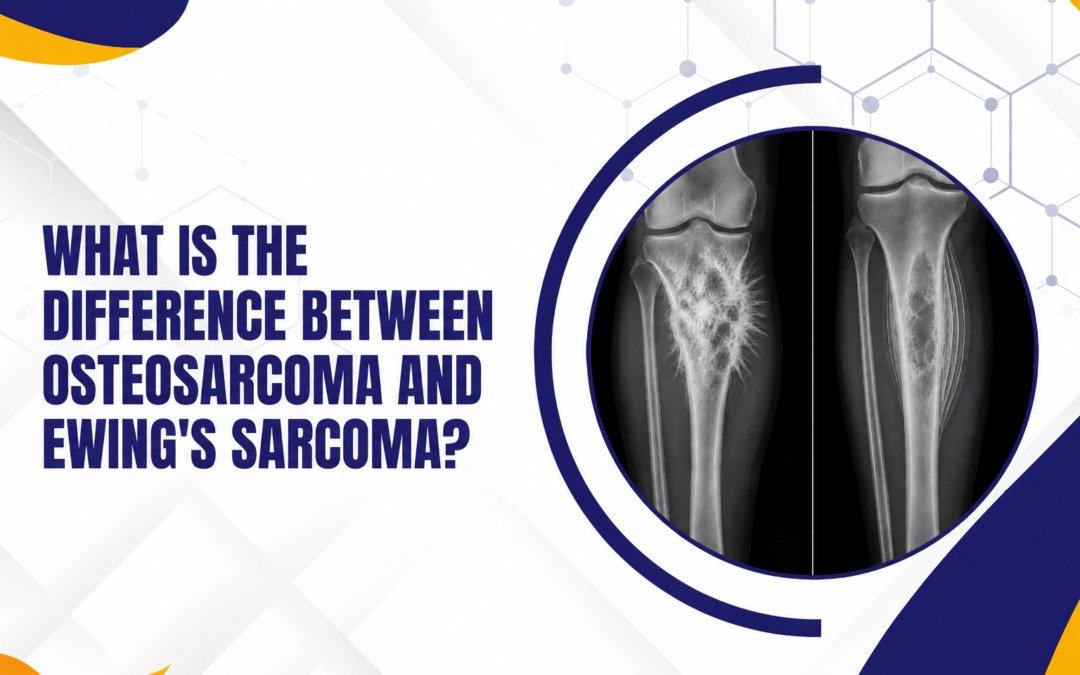
Cell origin changes everything: Osteosarcoma cells make abnormal bone matrix, which is why the tumour looks dense on X-ray. Ewing’s cells don’t make bone at all, so the lesion often looks more like it’s eating away at existing bone.
Location isn’t random: Osteosarcoma sticks close to the growth plate at a long bone’s end. Ewing’s has no such preference and turns up in the pelvis, ribs, or right in the middle shaft just as often.
The genetic marker settles the diagnosis: A confirmed EWSR1 translocation on biopsy is specific to Ewing’s sarcoma and clears up cases where imaging alone can’t. Osteosarcoma has no equivalent single marker.
Radiotherapy response drives treatment choice: Because Ewing’s responds well to radiation, it opens up an alternative to surgery in select cases. Osteosarcoma rarely gets that option, so surgery stays central to its treatment.
Ewing’s sarcoma in particular tends to get missed early since it mimics infection. Read more on Ewing’s sarcoma treatment and what parents should watch for.
Why Choose Dr. Aanchal Bhatia for Osteosarcoma and Ewing's Sarcoma Care in Bangalore?
Dr. Aanchal Bhatia completed her Fellowship in Musculoskeletal Oncology at Max Super Speciality Hospital, Saket, New Delhi, with dedicated training across paediatric and adult bone sarcoma cases. She’s a member of the Indian Musculoskeletal Oncology Society (IMSOS) and has 12 peer-reviewed publications to her name. Her practice focuses exclusively on bone and soft tissue tumour cases, osteosarcoma and Ewing’s sarcoma included, not as an occasional referral but as core clinical work. Every diagnosis here follows the same sequence: imaging first, biopsy next, histopathology to confirm. That process is what keeps two cancers that look similar on a first scan from getting mixed up.
Treatment sequencing, chemotherapy first for both cancers, then the choice between surgery and radiotherapy, gets worked out through tumour board discussion, not a single opinion. For Ewing’s sarcoma specifically, the radiotherapy option gets weighed seriously rather than skipped. Families get a clear explanation of why one path was chosen over another, not just what to do next.
Frequently Asked Questions
1. What's the main difference between osteosarcoma and Ewing's sarcoma?
Osteosarcoma forms bone tissue; Ewing’s sarcoma arises from primitive round cells instead.
2. Which cancer responds better to radiotherapy?
Ewing’s sarcoma responds well to radiotherapy; osteosarcoma generally does not.
3. Can both cancers be treated with limb salvage surgery?
Yes, both can often be treated with limb-preserving surgery when caught early.
4. How is the diagnosis confirmed between the two?
A biopsy and genetic testing for the EWSR1 marker confirm the diagnosis.
Reference
Disclaimer: This article is for educational purposes only and does not replace professional medical advice; please consult a qualified orthopedic oncologist for diagnosis and treatment.