Quick Summary
Conditions treated
Provider
Treatment plan
Location
Surgery for Bone and Soft Tissue Tumours: Options and Reconstruction
Finding a “bone cyst” on an X-ray or scan can naturally raise questions about whether it is serious or requires treatment.
Most bone cysts are benign, but some can cause pain, weaken the bone or increase the risk of fracture. Treatment depends on the cyst’s type, size, location, the patient’s age and overall bone health. Dr. Aanchal Bhatia provides specialist evaluation for bone cysts and other bone lesions in Bangalore, with treatment or monitoring planned according to each patient’s needs.
What Are the Surgical Options for Bone and Soft Tissue Tumours?
Limb-Salvage Surgery
Limb-salvage surgery involves removing the tumour while preserving the affected arm or leg.
The goal is to remove the tumour safely without unnecessarily sacrificing the limb. However, preserving the limb is only one part of the decision. The surgeon also needs to consider whether the limb will have a useful function after surgery.
Depending on what needs to be removed, the bone, joint or surrounding soft tissues may need to be reconstructed. This is why tumour removal and reconstruction are often planned together.
Wide Local Excision
Wide local excision involves removing a tumour along with an appropriate margin of surrounding tissue.
The amount of tissue that needs to be removed depends on the tumour’s size, location and extent. The aim is to remove the tumour adequately while preserving as much healthy tissue and function as possible.
Endoprosthetic Reconstruction
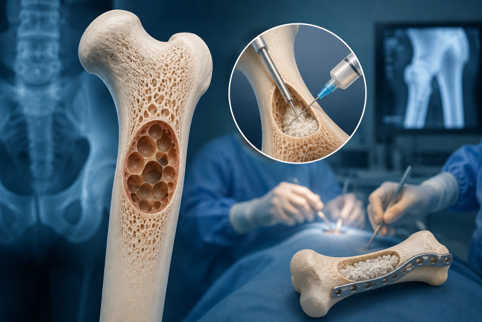
Sometimes, tumour removal involves a large section of bone or part of a joint. In such cases, the missing section may be replaced using a specialised metal implant. This is known as endoprosthetic reconstruction.
The type of implant depends on the part of the bone or joint involved and the amount of bone that has been removed. The reconstruction is planned to provide stability and support useful limb function during recovery.
Biological Reconstruction
Biological reconstruction is an important part of limb-salvage surgery in selected patients.
Instead of replacing a bone defect only with a metal implant, the affected area may be reconstructed using biological methods. Depending on the situation, this may involve an autograft, using the patient’s own bone, or an allograft, using donor bone.
In selected cases, the patient’s own tumour-bearing bone may also be processed and reused for reconstruction.
The choice of biological reconstruction depends on several factors, including the location and size of the bone defect, the patient’s age and overall condition, and the expected function after surgery.
Bone and Soft Tissue Reconstruction
Surgery for bone cancer or other tumours can sometimes leave a defect in the bone or surrounding tissues. Reconstruction may be needed to restore strength and function. Depending on the case, this may involve a bone graft, an implant or biological reconstruction. If nearby muscles, tendons, nerves or blood vessels are affected, they may also need to be repaired or reconstructed.
How Is the Surgical Approach Decided?
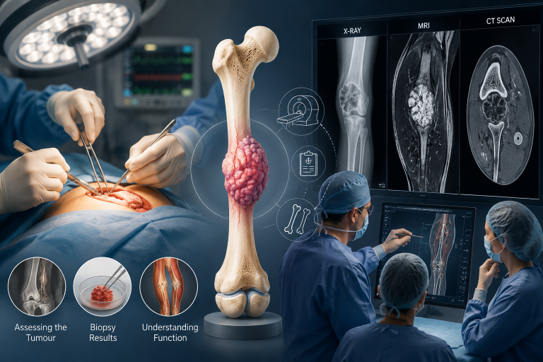
Before surgery, the tumour is assessed using imaging, biopsy results and clinical examination. MRI and CT scans can help show the location and extent of the tumour and its relationship with nearby bones, joints, muscles, nerves and blood vessels.
The surgeon also needs to consider how the limb is likely to function after the tumour has been removed.
In some patients, limb-salvage surgery may allow the tumour to be removed while retaining useful limb function. In other situations, preserving the limb may not be safe or may result in very limited function. These factors are considered when deciding on the most appropriate surgical approach.
What Happens During Tumour Surgery?
The exact procedure depends on the tumour and the area being treated. However, surgery generally involves several important steps:
Planning
Tumour removal
Reconstruction
Repair of nearby structures
Rehabilitation
Recovery After Tumour Surgery
Recovery can vary considerably from one patient to another. Someone who has had a smaller soft tissue tumour removed may have a different recovery experience from someone who has undergone major bone or joint reconstruction.
Recovery depends on the location of the tumour, the extent of surgery and the type of reconstruction performed.
Hospital stay
Physiotherapy
Weight-bearing
After lower-limb surgery, weight-bearing may be restricted initially and gradually increased as healing progresses.
Strength and movement
Follow-up
Need to Understand Your Surgical Options?
Being told that you need surgery can raise many questions, especially when limb-salvage surgery and reconstruction are being considered.
A consultation can help you understand your diagnosis, the surgical options available and whether limb-salvage surgery or a particular type of reconstruction may be appropriate in your case.
Why Choose Dr. Aanchal Bhatia for Tumour Surgery in Bangalore?