

A bone cancer diagnosis usually comes with a stage attached, somewhere between I and IV. That number isn’t arbitrary. It comes from four things looked at together: how large the tumour is, where it sits, what the cells look like under a microscope, and whether the disease has moved past its original spot. The AJCC TNM system covers three of these (Tumour, Node, Metastasis), and grade gets folded in separately. From there, the stage becomes the reference point for almost everything else, including how aggressive the surgery needs to be and whether chemotherapy enters the picture at all.
According to Dr. Aanchal Bhatia, orthopedic oncologist in Bangalore, “Two patients can have tumours of the exact same size and still land on different stages. Grade decides more of the outcome than most people expect.”
How Does the TNM System Grade a Bone Tumour?
Three factors get examined before a treatment plan even starts taking shape.
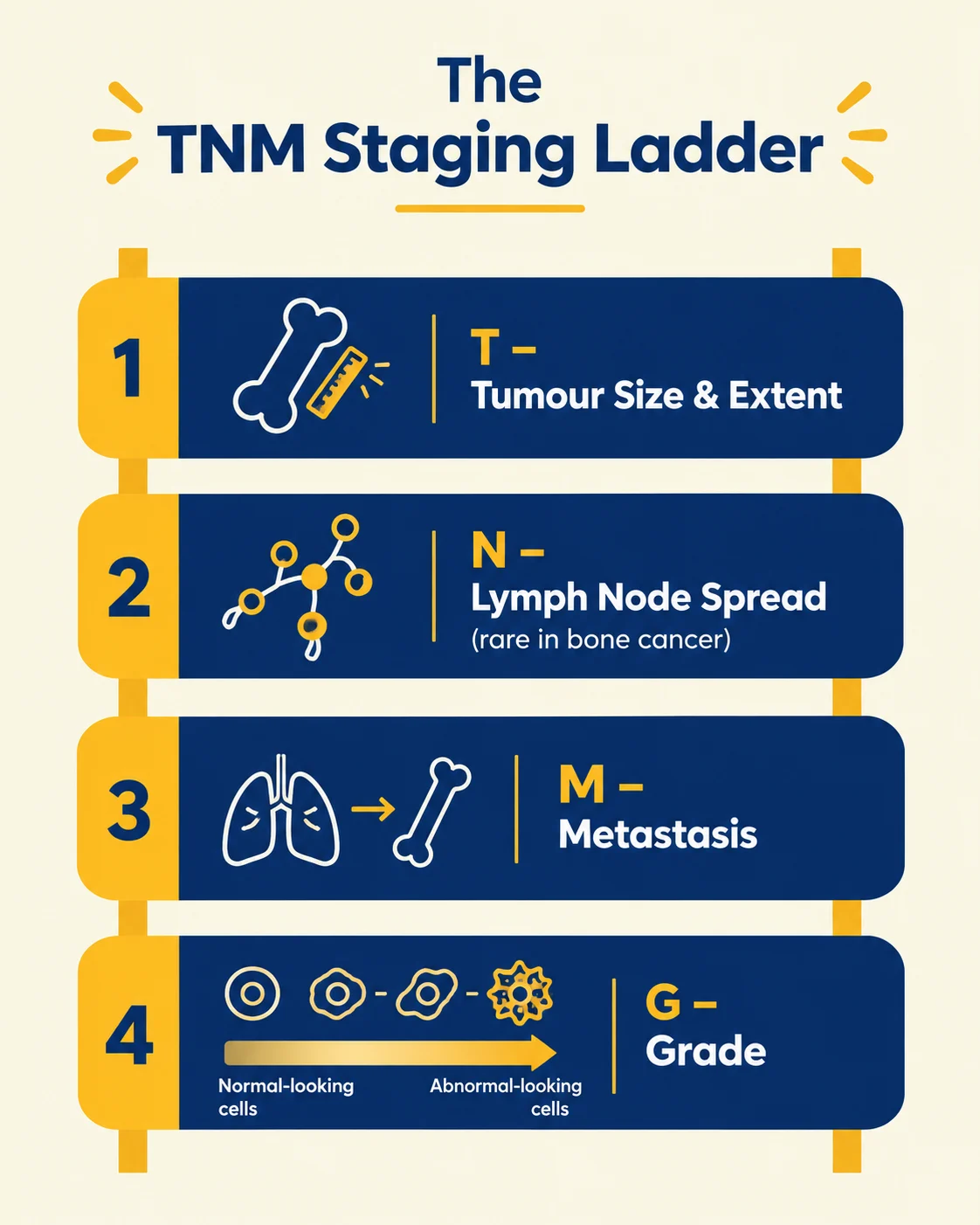
Grade ends up mattering more here than in most cancers people are familiar with. Under the microscope, a G1 tumour looks close enough to ordinary tissue and grows at a slow pace. G2 and G3 look rougher, more chaotic, and grow faster. So it’s entirely possible for two tumours the same physical size to sit at different stages, purely because one behaves more aggressively than the other. Lymph node spread, which drives staging in cancers like breast or colon cancer, barely factors in here. Bone sarcomas rarely touch the lymph nodes, so N0 is the default reading in most cases. What actually shifts the stage is the M category, and when the disease does spread, it tends to head for the lungs first.
Wondering how staging shapes what happens next in your specific case? You can explore the bone cancer treatment in Bangalore page to understand how each stage can influence the surgical plan.
Staging changes the treatment plan, not just the label. Get an accurate one before deciding anything else.
What Are the Four Stages of Bone Cancer?
The stage number is really shorthand for how far along things are, and how quickly action is needed.
|
Stage |
Grade |
Tumour Extent |
Spread |
|
I |
Low-grade (G1) |
Confined to the bone |
None |
|
II |
High-grade (G2/G3) |
Confined to the bone |
None |
|
III |
High-grade |
Multiple sites within the same bone |
Localized only |
|
IV |
Any grade |
Any size |
Beyond the bone (lungs, other bones, organs) |
Stage I: Slow and contained. Low-grade, hasn’t left the bone. Surgery on its own is often the entire treatment.
Stage II: Local, but quicker to grow. The higher grade pushes recurrence risk up, which is why chemotherapy typically gets paired with surgery at this point.
Stage III: Same bone, more than one spot. Nothing has escaped the bone yet, but the scattered pattern means surgeons need wider margins than usual.
Stage IV: Past the bone’s borders. Spread has occurred, most often to the lungs, and the treatment goal shifts toward managing disease in more than one place at once.
Staging concepts like these come up constantly with two cancers often confused for one another. Our post on the difference between osteosarcoma and Ewing’s sarcoma breaks down how staging plays out differently between the two.
Why Choose Dr. Aanchal Bhatia for Bone Cancer Staging in Bangalore?
Dr. Aanchal Bhatia trained in Orthopaedics at Ramaiah Medical College and went on to complete a Fellowship in Musculoskeletal Oncology at Max Super Speciality Hospital, Saket, New Delhi. She has authored 12 peer-reviewed publications, and her practice focuses exclusively on bone and soft tissue tumour cases. Nothing about staging gets rushed. Imaging, biopsy results, and tumour grade are looked at together, and patients hear their diagnosis explained plainly, not buried in jargon.
Frequently Asked Questions
1. What does a Stage IV diagnosis mean for bone cancer?
It means the disease is no longer confined to the original bone. Most often it has reached the lungs, sometimes another bone.
2. Does the stage of bone cancer change once treatment starts?
The stage set at diagnosis stays on record. If the disease responds or shifts during treatment, doctors track that separately rather than reassigning a new stage.
3. Is a higher stage automatically a worse prognosis?
Not necessarily. Two patients at the same stage can have very different outcomes, since grade and location weigh in just as heavily as spread does.
4. Do all bone cancers get staged the same way?
They don’t. Osteosarcoma, chondrosarcoma, and Ewing sarcoma each come with their own staging quirks, tied to how each one tends to progress.
Reference
Disclaimer: This article is for educational purposes only and does not replace professional medical advice; please consult a qualified orthopedic oncologist for diagnosis and treatment.