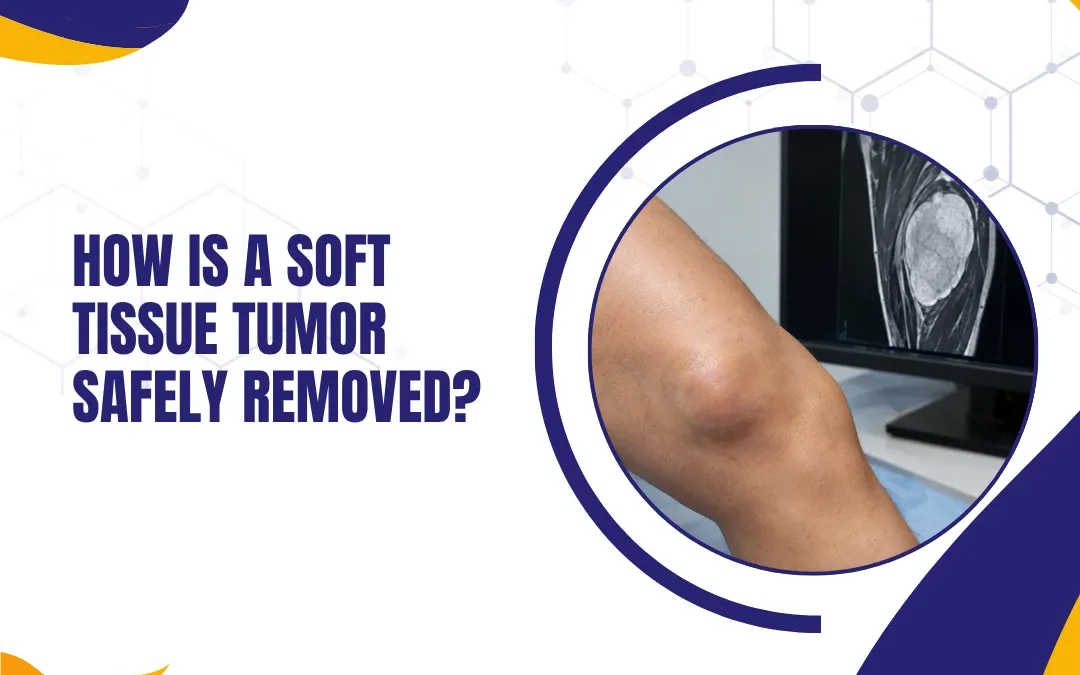
One thing decides most of it: the margin. Surgeons take the tumor out along with a rim of healthy tissue around it, wide enough to clear any stray cells, careful enough to leave the nerves, blood vessels, and muscle doing their job afterward. Tumors in an arm or leg usually call for a limb-sparing approach rather than anything more drastic. Whatever the tumor type, the target stays fixed. Get it all out, keep the limb working.
According to Dr. Aanchal Bhatia, orthopedic oncologist in Bangalore, “A wide margin isn’t negotiable. What takes skill is getting that margin without taking more of the limb than the tumor actually calls for.”
What Determines the Surgical Margin for a Soft Tissue Tumor?
Margin size isn’t fixed in advance. A few specific findings decide it case by case.
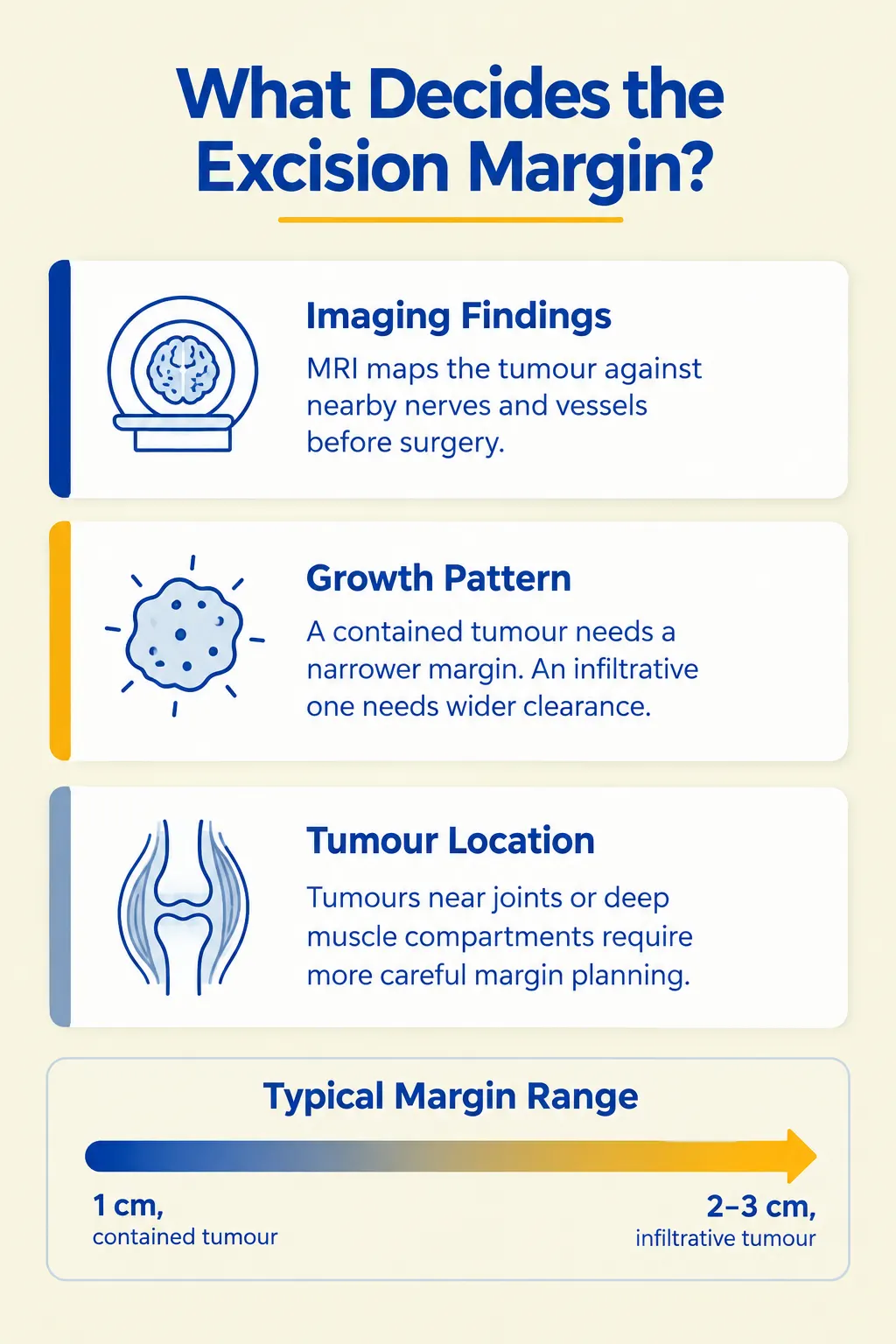
An MRI done ahead of time maps where the tumor sits against the nerves and vessels nearby. That map is what tells the surgeon whether 1 cm clears it or whether the tumor’s growth pattern demands closer to 3. Tumors that grow diffusely, without a clean edge, tend to need the wider margin. Location matters too. Something sitting deep in a muscle compartment or right against a joint gets planned differently than a tumor sitting closer to the surface.
Curious how this applies to a specific diagnosis? The soft tissue sarcoma treatment in Bangalore page covers how margin planning fits into the broader treatment approach.
A margin that’s too narrow raises recurrence risk. Get it planned properly the first time.
What Steps Are Involved in Soft Tissue Tumor Excision?
The sequence stays fairly consistent from case to case. Size and location shift the specifics.
| Step | What Happens |
| Biopsy | Confirms tumor type before any excision is planned |
| Imaging review | MRI maps the tumor against nearby nerves and vessels |
| Excision | Tumor removed with a healthy tissue margin |
| Margin check | Pathologist examines the edges for remaining cells |
| Reconstruction (if needed) | Graft, flap, or implant restores structure |
- Biopsy comes first. No exceptions. Cutting straight to excision without knowing the tumor type risks a margin that’s too narrow, and a second surgery down the line.
- Margin planning happens on paper before it happens in the operating room. Resection lines get mapped against imaging so there’s no guessing once the procedure starts.
- Excision takes the tumor out with its margin attached. In some cases, the specimen goes to pathology while the patient’s still on the table.
- Reconstruction fills whatever gap function leaves behind. A muscle flap, a skin graft, sometimes synthetic material. Depends entirely on how much tissue came out.
Bone tumor surgery follows a slightly different path, but the margin principle carries straight across. Our post on what limb salvage surgery for bone cancer involves covers how that overlap shows up for tumors sitting close to bone.
Why Choose Dr. Aanchal Bhatia for Soft Tissue Tumor Excision in Bangalore?
Dr. Aanchal Bhatia trained in Orthopaedics at Ramaiah Medical College, then completed her Fellowship in Musculoskeletal Oncology at Max Super Speciality Hospital, Saket, New Delhi, with hands-on work in soft tissue tumor excision and reconstruction planning. She’s a member of the Indian Musculoskeletal Oncology Society (IMSOS), has authored 12 peer-reviewed publications, and treats bone and soft tissue tumor cases only.
Margin planning is based on each patient’s own imaging and tumour characteristics rather than a fixed template. What the limb needs to keep working matters just as much in that plan as what it takes to clear the tumor.
Frequently Asked Questions
1. Is soft tissue tumor removal painful afterward?
Some soreness for the first week or two is normal. Standard pain medication manages it, and discomfort eases as the wound heals.
2. Can a soft tissue tumor be removed without a biopsy first?
It’s not advisable. Removing a tumor before its type is known risks an inadequate margin, which often means a second surgery to fix it.
3. Does removing a soft tissue tumor always need reconstruction?
Not always. Smaller tumors with minimal tissue loss frequently heal on their own, without a graft or flap. Larger excisions tend to need it.
4. Can a soft tissue tumor come back after excision?
Yes, particularly with a narrow or positive margin. That’s exactly why the pathology check on removed tissue carries as much weight as the surgery itself.
Reference
Disclaimer: This article is for educational purposes only and does not replace professional medical advice; please consult a qualified orthopedic oncologist for diagnosis and treatment.