

Not every patient qualifies, but far more do than people generally assume. Roughly 19 out of 20 bone sarcoma cases today end in a saved limb, a number that has moved up steadily as imaging and reconstruction techniques have gotten better. A smaller share of patients still run into anatomical or medical roadblocks that take limb salvage off the table entirely, and for them, amputation or another approach becomes the only realistic path.
According to Dr. Aanchal Bhatia, orthopedic oncologist in Bangalore, “Patients often assume amputation is the fallback plan. In practice, it’s the exception, reserved for tumours that leave surgeons no safe alternative.”
What Factors Decide If Limb Salvage Is Possible?
A few specific findings from imaging and biopsy work end up deciding this, more than anything else.
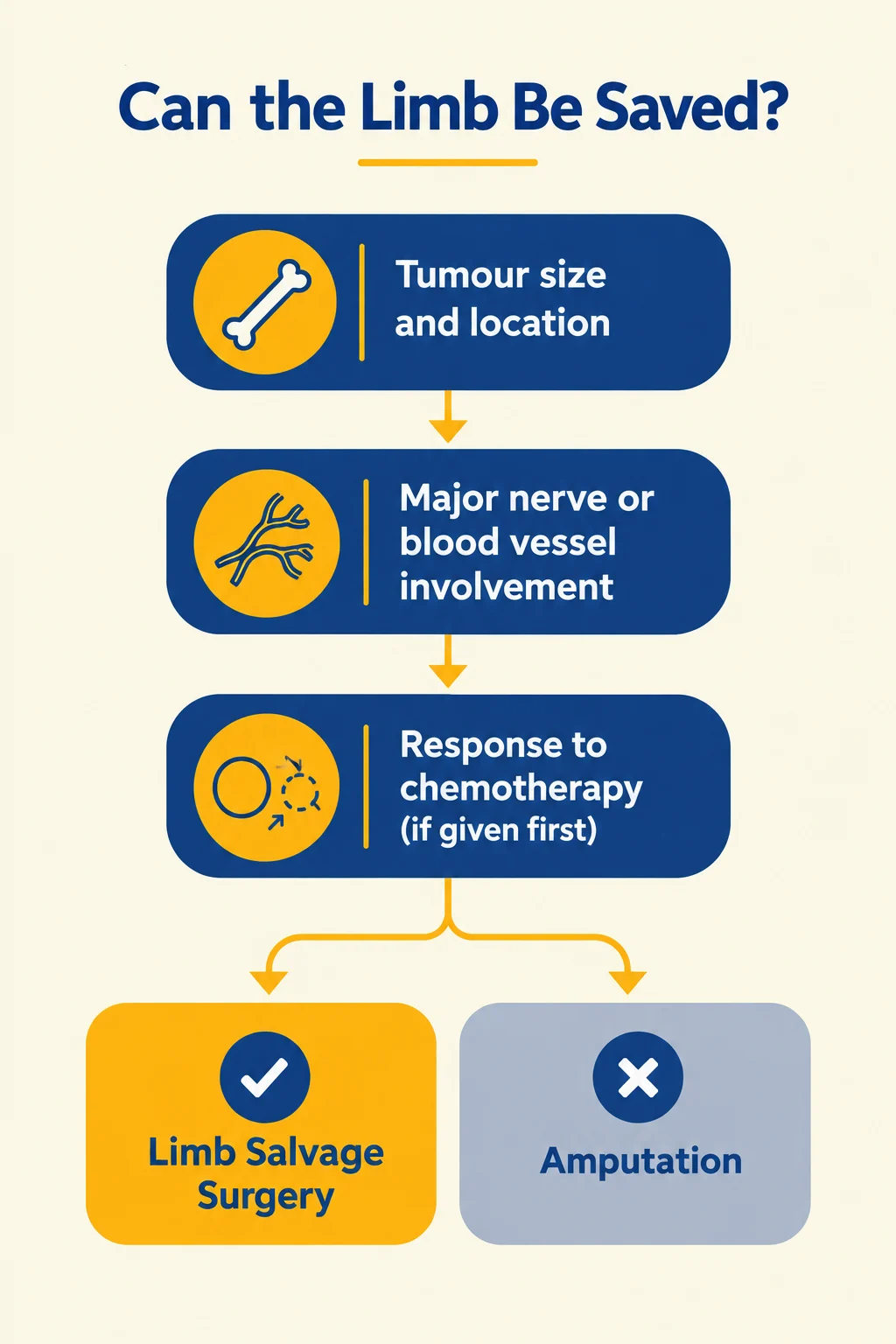
Size on its own rarely closes the door on limb salvage. What actually shifts the decision is whether the tumour has reached the major nerves or blood vessels running through the limb, since rebuilding around bone is a lot more manageable than rebuilding around those. When a tumour doesn’t shrink well with chemotherapy given ahead of surgery, that raises a separate question: has it stayed within a resectable area, or grown past what the scans originally showed? Age, general health, and the amount of bone that would need replacing come into the decision too.
Curious whether limb salvage applies to your specific diagnosis? The bone cancer treatment in Bangalore page covers how these factors can shape the surgical plan.
Limb salvage depends on the tumour and other clinical factors. Get an evaluation before assuming either way.
When Is Amputation Preferred Over Limb Salvage?
A handful of situations still push the decision toward amputation, even with how far surgical options have come.
| Factor | Limb Salvage Usually Possible | Amputation Often Needed |
| Nerve/vessel involvement | Not involved | Major nerves or vessels encased by tumour |
| Tumour response to chemo | Shrinks or stabilizes | Continues growing despite treatment |
| Infection risk | Low, wound heals well | Active infection or poor tissue health |
| Recurrence after prior surgery | First occurrence | Tumour has recurred at the same site |
- Nerve or vessel encasement: this is what settles it most of the time. Once a tumour wraps around the nerves or vessels feeding the limb, taking it out cleanly without amputation stops being realistic.
- Poor chemotherapy response: a caution flag, though not a final verdict on its own. Continued growth despite treatment pushes surgeons to look again at whether a safe margin is even achievable.
- Recurrence at the same site: things get harder the second time around. A tumour returning where limb-salvage surgery was already done leaves a much narrower set of safe choices.
- Patient choice: occasionally the real reason, and a valid one. A few patients opt for amputation on their own even when limb salvage remains medically viable, often weighing recovery time or long-term function.
There isn’t a single formula that applies across the board here. Each case gets looked at on its own terms. Our post on what limb salvage surgery for bone cancer actually involves covers how the procedure gets planned once someone qualifies.
Why Choose Dr. Aanchal Bhatia for Limb Salvage Evaluation in Bangalore?
Dr. Aanchal Bhatia completed her fellowship at Max Super Speciality Hospital, Saket, with training in limb-salvage procedures, prosthetic reconstruction, and the clinical decision-making involved in determining when amputation may be the safer option. She’s a member of the Indian Musculoskeletal Oncology Society (IMSOS) and has 12 peer-reviewed publications to her name, with a practice focused exclusively on bone and soft tissue tumour cases.
Cases get reviewed against actual imaging and biopsy findings rather than a general rule of thumb, so patients walk away with a straight answer about which option fits their situation.
Frequently Asked Questions
1. Can limb salvage always avoid amputation?
Not always. If a tumour has already grown into the major nerves or blood vessels, amputation can end up being the only safe route.
2. What percentage of bone tumour patients qualify for limb salvage?
Somewhere between 90 and 95 percent of patients with tumours in the arms or legs turn out to be candidates, depending on where the tumour sits and how far it extends.
3. Does limb salvage increase the risk of the tumour returning?
It doesn’t, as long as the surgery achieves clear margins. Recurrence rates end up comparable between limb salvage and amputation when the procedure goes well.
4. Can limb salvage still work if the tumour sits close to major nerves?
Sometimes, provided the nerve itself hasn’t been directly encased. This gets checked closely, since nerve involvement is one of the biggest reasons limb salvage gets ruled out.
Reference
Disclaimer: This article is for educational purposes only and does not replace professional medical advice; please consult a qualified orthopedic oncologist for diagnosis and treatment.